We’re thrilled to announce that holiday comparison provider icelolly.com will take center stage at June’s Data, Analytics & Insight Leaders Masterclass in Manchester by delivering the official keynote presentation.
The presentation by Gemma Needham and Reema Vadoliya will provide delegates with a real-life case study and will highlight icelolly’s journey from a basic analytics setup to implementing a dynamic and customisable system and how this advanced data analytics infrastructure has enabled icelolly to use rich data to best identify opportunities for their customers.
The event, which is the 11th in the Marketing Masterclass Series, will also see former PZ Cusson’s Global Digital Director Paul Morris act as the Official Master of Ceremonies.
The #DATAMANC18 masterclass will be held in the Gattatt Suite at the Museum of Science and Industry in Manchester on Tuesday 5th June 2018.
With many of the UK’s biggest brands already confirmed to attend #DATAMANC18, delegates will have full access to a unique learning experience through a series of engaging roundtable sessions that will explore the key challenges and opportunities in how brands can harness powerful consumer and audience data to drive marketing performance and campaign success.
The Data, Analytics & Insight Leaders Masterclass is produced by Marketing Masterclass Series in association with Acrotrend, Boxclever, The Data Shed, Search Laboratory, Adthena, Go Inspire and Forward Role Recruitment.
As part of our build-up to next week’s Paid & Biddable Leaders Masterclass in Leeds, Epiphany’s Arianne Donoghue examines the area of campaign tracking, and how marketers can use cross-channel data to maximise their results.
One of the biggest challenges in marketing in recent years has been around tracking the value and efficacy of our campaigns. I believe that our focus on last-click conversions could be significantly damaging our marketing, but not in the way you think. This isn’t about attribution, after all.
As someone who’s worked in paid media for over a decade, I know that one of its biggest attractions is measurability – the way we know exactly what return we generate and can optimise to further increase it. However, one of the biggest flaws is the focus on last-click – which we know can lead to more of a focus on bottom-of-the-funnel activity, rather than looking at the top of the funnel and the initial interactions that customers make. We see this at a basic level in the performance of brand vs non-brand keywords and the sometimes poorly perceived value of Display campaigns.
While last-click and attribution are definitely part of the problem here, I’d like to suggest that our quest for ROI can also make things worse in some instances. Let me explain.
The Wrong KPIs
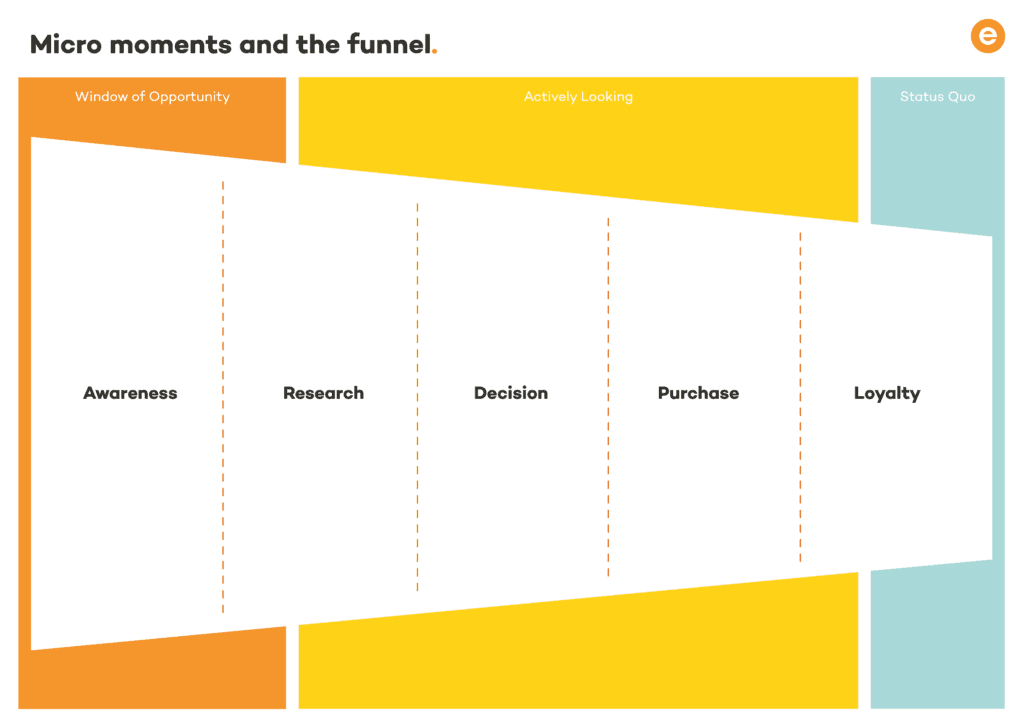
Let’s say that you’re running a Display Prospecting campaign. That sits pretty squarely in the top of the marketing funnel – most likely in the Awareness/Research stages.
Ultimately, what is the goal of a prospecting campaign? Eventually, we want it to drive sales/revenue, but this can take a long time – sometimes well beyond the scope of a regular 30 or 90-day cookie window. This is complicated further by the need for robust impression tracking in Analytics to understand when a sale has been driven.
However, if we really think about it, the goal of the campaign, particularly in the short to medium-term, is to find new users who are unfamiliar with your brand and bring them to the website for the very first time. Once this is done, you could argue that prospecting has done its job and it’s now over to Retargeting and Paid Search to get that user to the point of conversion. Yet, rather than assess this campaign’s success on how many new visitors it drove, we use the KPI of our end-goal conversion.
Not Enough Conversions
Another instance where the approach can cause problems is in optimising Paid Search campaigns. Often, marketers may be trying to optimise their paid search campaigns without enough conversion data to make reliable bidding decisions.
This issue is more prevalent with non-brand keywords, which are less likely to drive last-click sales anyway. It doesn’t mean the keywords are adding no value – in fact, we know that if we paused these terms, we’d probably be losing conversions further down the line.
The Solution
How do we fix this? I believe the solution is to have a greater focus on micro conversions when it’s appropriate to do so.
What are micro conversions?
“Micro conversions are activities that users frequently engage in before purchasing. Sites commonly have several kinds of micro conversions, e.g. email sign-up, created account, PDF download, extensive site browsing”
The value of micro conversions is also something Avinash Kaushik wrote about extensively almost ten years ago – I highly recommend reading this blog post he wrote on the subject.
Avinash believes, as do I, that looking at micro conversions in addition to macro ones allows us to better understand the behaviour of the distinct personas who use your site; it forces you to look at more of the multi-channel picture. When we ignore them, we’re saying that we don’t value the users who spend significant time on our websites, or those who signed up to receive emails, or even those who went to the trouble of creating an account. Just because they’re not ready to buy right now, it doesn’t mean they never will and we should look after and value these users.
Of course, with some of our marketing efforts we can create remarketing lists that specifically target these users to help bring them to the point of finally converting. But the credit for those macro conversions would go to the later activity – as it arguably should do, as the job of those channels is to drive conversion. But we would still be undervaluing the activity that drove the micro conversions because we just don’t value them as highly.
Attribution
I know I said this post wasn’t about attribution and it’s not – mostly. Thankfully the increased use of attribution and data-driven models, in particular, is helping to address this issue. Data-driven attribution looks at all of the micro conversions and assigns macro conversion value based on the part that every interaction played across the whole journey.
Still a challenge, however, is the fact that few businesses are set up to use data-driven attribution to help shape their use of channels and budgets. Analytics and Attribution solutions that offer impression tracking can be expensive and not all solutions offer a data-driven model to work with. What can you do if that’s the case?
Firstly, ensure you have goals set up to track your micro conversions and assign a value to these. Report on them as well as your macro conversions and consider using traffic and brand awareness increase as KPIs for certain types of Display and other upper-funnel activities. In the vast majority of businesses, most customers won’t convert on their very first interaction with a new brand – so our measurement and reporting should reflect that.
With more and more businesses understanding the need to look at the whole customer journey, I believe this approach enables us to better judge the success of our marketing campaigns, and the impact they have, at the right point of the customer journey in the right way.
Having started off her digital career client side over a decade ago, Arianne has worked for both agencies and brands in-house, specialising in search. She is now back agency side supporting on biddable media digital strategy. A regular on the conference scene, she’s also an editor and contributor at popular site State of Digital.
Arianne Donoghue is the Paid Media Development Manager at Epiphany, and will be leading a session on ‘Using Cross Channel Data to Help Your Campaigns Work Harder’ at next week’s Paid & Biddable Leaders Masterclass in Leeds.
Cookie Consent
We use cookies to improve your experience on our site. By using our site, you consent to cookies.
Cookie Preferences
Manage your cookie preferences below:
Essential cookies enable basic functions and are necessary for the proper function of the website.
Name
Description
Duration
Cookie Preferences
This cookie is used to store the user's cookie consent preferences.
30 days
These cookies are needed for adding comments on this website.
Name
Description
Duration
comment_author
Used to track the user across multiple sessions.
Session
comment_author_email
Used to track the user across multiple sessions.
Session
comment_author_url
Used to track the user across multiple sessions.
Session
Statistics cookies collect information anonymously. This information helps us understand how visitors use our website.
Google Analytics is a powerful tool that tracks and analyzes website traffic for informed marketing decisions.
Contains information related to marketing campaigns of the user. These are shared with Google AdWords / Google Ads when the Google Ads and Google Analytics accounts are linked together.
90 days
__utma
ID used to identify users and sessions
2 years after last activity
__utmt
Used to monitor number of Google Analytics server requests
10 minutes
__utmb
Used to distinguish new sessions and visits. This cookie is set when the GA.js javascript library is loaded and there is no existing __utmb cookie. The cookie is updated every time data is sent to the Google Analytics server.
30 minutes after last activity
__utmc
Used only with old Urchin versions of Google Analytics and not with GA.js. Was used to distinguish between new sessions and visits at the end of a session.
End of session (browser)
__utmz
Contains information about the traffic source or campaign that directed user to the website. The cookie is set when the GA.js javascript is loaded and updated when data is sent to the Google Anaytics server
6 months after last activity
__utmv
Contains custom information set by the web developer via the _setCustomVar method in Google Analytics. This cookie is updated every time new data is sent to the Google Analytics server.
2 years after last activity
__utmx
Used to determine whether a user is included in an A / B or Multivariate test.
18 months
_ga
ID used to identify users
2 years
_gali
Used by Google Analytics to determine which links on a page are being clicked
30 seconds
_ga_
ID used to identify users
2 years
_gid
ID used to identify users for 24 hours after last activity
24 hours
_gat
Used to monitor number of Google Analytics server requests when using Google Tag Manager
1 minute
Marketing cookies are used to follow visitors to websites. The intention is to show ads that are relevant and engaging to the individual user.
A video-sharing platform for users to upload, view, and share videos across various genres and topics.
This cookie stores your preferences and other information, in particular preferred language, how many search results you wish to be shown on your page, and whether or not you wish to have Google’s SafeSearch filter turned on.
10 years from set/ update
YSC
Registers a unique ID to keep statistics of what videos from YouTube the user has seen.
Session
DEVICE_INFO
Used to detect if the visitor has accepted the marketing category in the cookie banner. This cookie is necessary for GDPR-compliance of the website.
179 days
LOGIN_INFO
This cookie is used to play YouTube videos embedded on the website.
2 years
GPS
Registers a unique ID on mobile devices to enable tracking based on geographical GPS location.
1 day
VISITOR_INFO1_LIVE
Tries to estimate the users' bandwidth on pages with integrated YouTube videos. Also used for marketing