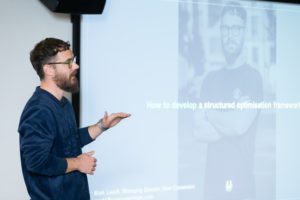
At our recent Digital Leaders Masterclass in Manchester, we were thrilled to see a huge turnout, with over 70 senior digital leaders from many of the UK’s most reputable brands and agencies in attendance.
The 12th event in the Marketing Masterclass Series took place on Tuesday 6th November in the heart of Manchester at the Museum of Science and Industry and provided delegates with the unique opportunity to discuss, debate and share knowledge on the big issues facing the digital – as we enter 2019.
Our Official Master of Ceremonies – WMG’s Director of Digital Operations Ian Lloyd (Right), welcomed delegates, before Mark Leach, User Conversion’s Managing Director and former Head of eCommerce at Missguided (below) delivered his keynote talkwhich provided delegates with an in-depth understanding on how to set up a structured CRO framework and how to utilise analytics for success.
Following the keynote presentation by Mark, delegates took part in a series of five roundtable sessions, which addressed the current and future developments that were shaping search marketing, data, CRO, UX, Content Marketing and emerging digital technologies.
The event also provided delegates with a fantastic networking opportunity, in which they were able to meet their peers from a wide range of industries. Delegates on the day included: Steinhoff, Matalan, Iceland, BBC, Virgin Media, Swinton Group, Arla, Footasylum, Hotter, Pets at Home, Slater and Gordon, BookingGo, Motors.co.uk, Cotton Traders, The Hut Group, Very.co.uk, Shearings, Aviva, Hermes, Countrywide PLC and many more…
In the post-event delegate survey, we managed to achieve a record 93% Positive Satisfaction Score. The event also achieved a record number of delegate registrations and continues to demonstrate the growing reputation and popularity of the Marketing Masterclass Series.
The Digital Leaders Masterclass was produced by the Marketing Masterclass Series in association with partners: McCann Connected, Edit, WMG, User Conversion, Search Laboratory, Blueclaw, LION+MASON, Digitaloft and Forward Role Recruitment.
We’ll be announcing further details about our 2019 event schedule very soon!
Digital transformation is high on the agenda for most modern businesses. In today’s guest post, LION+MASON’s UX Director Andrew Machin shares a selection of the latest digital transformation cases, and highlights the key learnings for marketers and brands.
Regardless of how established or how large a business is, digital transformation can be a tricky process to master. Ultimately, the rapid development of new technologies presents huge opportunities for organisations across sectors.
It’s this, along with increased pressure from customers and competitors embarking on their own transformations that are spurring businesses on. The question is, where do you start? What do you need to consider? The answer is different for every organisation, but there are some lessons to be learned from the best.
Amazon
A truly successful digital transformation will allow you as a business to disrupt the marketplace you’re in. Just take a look at Amazon. Their strategy presents a masterclass for digital disrupters, but any business anywhere can learn a thing or two from the brand.
It’s their use of consumer data that really sets Amazon apart. From how people read on their Kindles, to purchasing decisions, Amazon segment and analyse data to build a clear picture of their customers, and they use that to their advantage. This, along with their powerfully marketed own brand products that sell in the tens of millions, designed around that same customer data gives them such a grip on the market that’s hard to beat.
What we’ve learned: Effective use of data and a clear vision of how your products and services answer a customer need is what will give you the competitive edge, even in the most competitive markets.
Deliveroo
Deliveroo is just one of the new age fast food businesses shaking up the sector. So, what’s the difference between something like Deliveroo and your average local business delivering to your door? The answer lies in tech of course. Intuitive interfaces and apps make things even easier for customers.
But it’s the investment that Deliveroo are ploughing into their tech talent that makes them stand out to us. They’ve added 250 new tech roles in London alone this year. This manpower will enable them to run smarter, slicker services that outstrip the competition.
What we’ve learned: Tech may be driving businesses to transform digitally, but you need the right people to harness that technology and pitch it to your customers in the right way.
StubHub
There were more than a few digital challenges for ticket retailer StubHub before they changed their strategy. With cumbersome systems trying to cope with huge influxes of ticket transactions, the need to adapt and become agiler was vital to the brand’s survival. The answer – StubHub is moving to the cloud.
That’s not all though. Data showed that 50% of people were using their mobile devices to purchase tickets. In response, StubHub has developed native apps for Android and iOS that allow people to enter events using the mobile only.
What we’ve learned: StubHub’s use of tech and a focus on the customer enabled them to create innovative products that customers love and use and cement them as a leader in their field.
DHL
It can be easy to focus on B2C businesses when it comes to digital transformation success stories, but there are more than a few B2B companies out there worth watching. One is DHL. This is a business that’s absolutely clued up on how to use tech to its advantage by getting the whole business on board.
By implementing a patents programme, they actively encourage anyone in the business to come forward with ideas. In MD Paul Richardson’s words, “We believe that digital-led innovation and innovation in general can come from anyone.” This has opened the doors to innovations like their warehouse smart glasses, and a new vehicle service that’s reduced costs by 20% and increased goods capacity in transit by 70%.
What we’ve learned: Actively encouraging staff throughout the business to engage with their digital transformation has given DHL unique opportunities to innovate and stay ultra-competitive.
Hasbro
One of the main things that can derail a digital transformation project is a lack of customer knowledge. Hasbro is a great example of a business that recognised the role of data in its transformation and used the insights gathered to change its strategy. A brave move to be sure.
Rather than marketing to kids as the brand historically did, they started to market to the purchasers – the parents. Through social media channels and advertising at the right point in the customer journey, they’ve grown sales by up to $1 billion. But that’s not all, with innovative partnerships with digital companies like Buzzfeed, they’ve brought traditional games like Monopoly onto modern gaming platforms, extending their appeal.
What we’ve learned: Another example of how data can inform strategy, Hasbro changed their target audience and used digital platforms to engage with their audiences in new ways.
In conclusion…
Digital transformation is a challenging process to tackle. This has created as many obstacles as opportunities for companies looking to revolutionise the way they connect with customers and stay competitive in their marketplace.
There are inspiring examples from businesses across sectors who have taken their digital transformation by the horns and carved out a new niche for themselves. Using data to inform strategic decisions and creating a collaborative environment for staff to actively drive the process are two common threads in each of the cases we’ve looked at.
Each also uses tech not in isolation, but as a way of meeting customer expectations with innovative solutions. Ultimately, it’s about using all the intel you have to develop hard-hitting digital products that answer a need. And that’s what each of these businesses has done with aplomb.
Author Biog:
With over 17 years’ experience in UX and Digital, Andrew Machin, Founder and UX Director at LION+MASON has helped global brands such as John Lewis, Jet2, and Interflora create transformational digital experiences, from web applications to in-store retail experiences.
Through the success of such projects Andrew has received accolades that include high-profile awards that span innovation, strategy, design, and results, such as the Dadi Grand Prix Award and the Digital Impact Award for Innovation.
This experience has led to Andrew judging the Digital Experience Awards, being featured in .net magazine, lecturing at Leeds University, and speaking at seminars and conferences across the UK.
Andrew will be leading a roundtable session on UX & Online Customer Experience at our Digital Leaders Masterclass #DIGITALMANC18 in Manchester on Tuesday 6th November 2018.
Cookie Consent
We use cookies to improve your experience on our site. By using our site, you consent to cookies.
Cookie Preferences
Manage your cookie preferences below:
Essential cookies enable basic functions and are necessary for the proper function of the website.
Name
Description
Duration
Cookie Preferences
This cookie is used to store the user's cookie consent preferences.
30 days
These cookies are needed for adding comments on this website.
Name
Description
Duration
comment_author
Used to track the user across multiple sessions.
Session
comment_author_email
Used to track the user across multiple sessions.
Session
comment_author_url
Used to track the user across multiple sessions.
Session
Statistics cookies collect information anonymously. This information helps us understand how visitors use our website.
Google Analytics is a powerful tool that tracks and analyzes website traffic for informed marketing decisions.
Contains information related to marketing campaigns of the user. These are shared with Google AdWords / Google Ads when the Google Ads and Google Analytics accounts are linked together.
90 days
__utma
ID used to identify users and sessions
2 years after last activity
__utmt
Used to monitor number of Google Analytics server requests
10 minutes
__utmb
Used to distinguish new sessions and visits. This cookie is set when the GA.js javascript library is loaded and there is no existing __utmb cookie. The cookie is updated every time data is sent to the Google Analytics server.
30 minutes after last activity
__utmc
Used only with old Urchin versions of Google Analytics and not with GA.js. Was used to distinguish between new sessions and visits at the end of a session.
End of session (browser)
__utmz
Contains information about the traffic source or campaign that directed user to the website. The cookie is set when the GA.js javascript is loaded and updated when data is sent to the Google Anaytics server
6 months after last activity
__utmv
Contains custom information set by the web developer via the _setCustomVar method in Google Analytics. This cookie is updated every time new data is sent to the Google Analytics server.
2 years after last activity
__utmx
Used to determine whether a user is included in an A / B or Multivariate test.
18 months
_ga
ID used to identify users
2 years
_gali
Used by Google Analytics to determine which links on a page are being clicked
30 seconds
_ga_
ID used to identify users
2 years
_gid
ID used to identify users for 24 hours after last activity
24 hours
_gat
Used to monitor number of Google Analytics server requests when using Google Tag Manager
1 minute
Marketing cookies are used to follow visitors to websites. The intention is to show ads that are relevant and engaging to the individual user.
A video-sharing platform for users to upload, view, and share videos across various genres and topics.
This cookie stores your preferences and other information, in particular preferred language, how many search results you wish to be shown on your page, and whether or not you wish to have Google’s SafeSearch filter turned on.
10 years from set/ update
YSC
Registers a unique ID to keep statistics of what videos from YouTube the user has seen.
Session
DEVICE_INFO
Used to detect if the visitor has accepted the marketing category in the cookie banner. This cookie is necessary for GDPR-compliance of the website.
179 days
LOGIN_INFO
This cookie is used to play YouTube videos embedded on the website.
2 years
GPS
Registers a unique ID on mobile devices to enable tracking based on geographical GPS location.
1 day
VISITOR_INFO1_LIVE
Tries to estimate the users' bandwidth on pages with integrated YouTube videos. Also used for marketing